
Safety leadership at Board level
Page Published Date:
March 30, 2026

Safety leadership at Board level:
What our conversation in Brisbane revealed
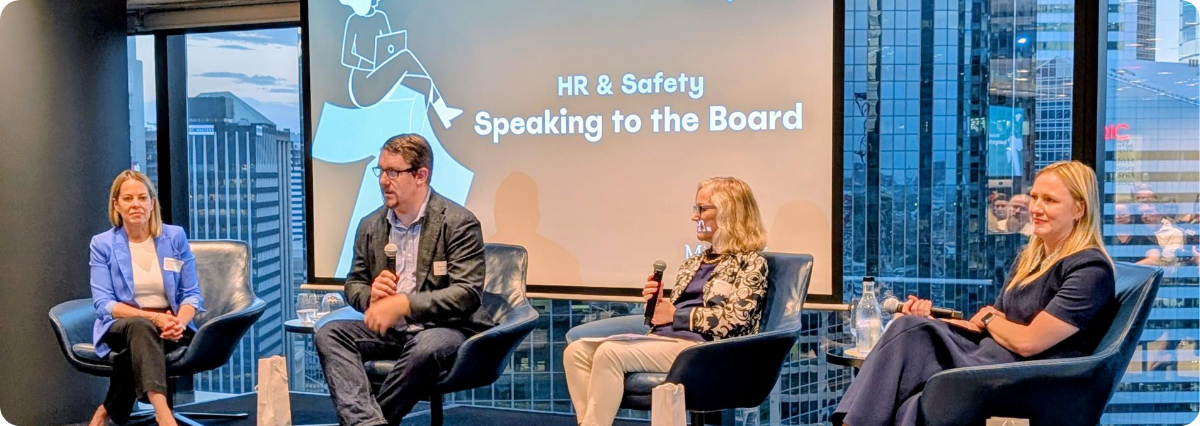
There is a version of safety leadership that stays in its lane: manages the annual regulatory reporting, tracks the lag indicators and reports to the Board when something goes wrong. And then there is the version that the panel at last week's Brisbane event put forward: a function that operates with genuine strategy, is proactive in mitigating enterprise risk and capable of future-focused, organisation-wide thinking.
The gap between those two versions, of course, is significant. And closing it is becoming important.
Co-hosted by The Safe Step, The Next Step, and MinterEllison, the event brought together Deanna McMaster (Partner, MinterEllison), Jane Keating (Board Director and former Head of HR at QTC), and Wade Needham (Head of ESG and EHS at Natural Resources) for a candid conversation about what Boards actually need from safety leaders and where the opportunities are.
The regulatory moment
Deanna opened with a clear-eyed assessment of the current environment. The ASIC v Star Entertainment Group judgment will fundamentally change what Board directors expect from the reports they receive and who is held accountable when those reports aren’t up to scratch.
"Every director I work with is acutely tuned into the Star decision. It says: if you're getting too much information, that's your fault – send it back.
And it absolutely calls out the role that Boards play in workplace culture."
— Deanna McMaster, Partner, MinterEllison, speaking at the event
For safety professionals, the implications are direct. Psychosocial safety now sits squarely at the intersection of HR and safety, and if the two functions are not producing a single, coherent, concise narrative for the Board, the papers may not make it through at all.
"If we're not collaborating, our reports aren't going to make it through to the Board pack.
We're going to have to get new ways of delivering some of the information we're used to working with."
— Deanna, speaking at the event
Rethinking what we measure
Wade Needham offered one of the most practically useful contributions of the evening: a challenge to the way most safety functions think about measurement. Drawing on his time leading health and safety at Serco, he described watching nurses and cleaners in their late forties and fifties gradually wear out under workload pressure, a pattern that was entirely visible in the data, if anyone had been looking at the right indicators.
"We would see absenteeism increase, leave balances get drawn down, time and attendance shift… and then within four months that person was on workers' comp. We didn't look back at trying to fix the work to match the person."
— Wade Needham, Head of ESG and EHS, speaking at the event
The point wasn’t about workers' compensation costs, but what safety leaders choose to surface and action. Many organisations are still dominated by lag indicators like injury rates, near-misses and claims. Leading indicators, by contrast, tell a predictive story and building an industry-specific leading indicator framework is one of the most valuable things a safety leader can do.
"We don't need more indicators. We need to better tell our story…
and the story is about what the business's exposure is, and what we're trying to deliver."
— Wade Needham, speaking at the event
AI: risk or opportunity?
The conversation turned to artificial intelligence and Wade's take was deliberately counter-intuitive. Where most governance discussions about AI focus on risk and regulation, he argued that safety leaders are uniquely positioned to use the AI transition as a strategic opportunity.
If you approach AI through a psychosocial lens, you can identify which tasks and roles are generating the most load on workers and make the case for automation as a wellbeing intervention, not just a productivity play. That reframe positions safety not as a compliance function reacting to change, but as a function driving it.
"You could sit there from a strategic perspective and, instead of playing the compliance game, be involved in the transition of your workforce. Psychosocial risk is very important for understanding what performance looks like and what workers need to have a valuable experience at work."
— Wade Needham, speaking at the event
What Boards actually want
Jane Keating, who brings both a deep HR background and active Board experience, was direct about what distinguishes safety leaders who get heard from those who don't.
"Think like a Board member. Think broadly – state context, national context, international context. Lead with a strategic idea…
And then bring in the data."
— Jane Keating, Board Director, speaking at the event
She described a simple framework — What, So What, Now What — that she has used to structure Board communications throughout her career. The ‘What’ is the data. The ‘So What’ is what it means for the organisation. The ‘Now What’ is what the safety team is going to do about it. Applied consistently, it transforms reporting from a compliance exercise into a strategic conversation.
The bigger picture
The underlying idea that connected the conversation threads of the evening was that the safety profession has a genuine opportunity to operate at a level of strategic influence it has not traditionally occupied, but leaders need to proactively choose to take that step.
That means developing commercial literacy, building relationships outside the safety function and presenting to Boards in their language, not the regulator's. And it means being willing to be uncomfortable; to move from owning a function to facilitating outcomes.
We’re seeing regulatory change driving Board attention to people and safety risk, and the Star judgment is creating appetite for better-quality reporting. ESG frameworks and incoming social disclosure requirements are creating new pathways for safety leaders to tell their story at shareholder level. And psychosocial safety is putting human experience above physical hazards on the governance agenda.
The question for every safety leader in the room is the one Wade posed directly: are you waiting for people to come to you, or are you going to them first with a solution?