From Compliance to Capability: Insights from the Annual AIHS NSW OHS Breakfast
Page Published Date:
May 6, 2026

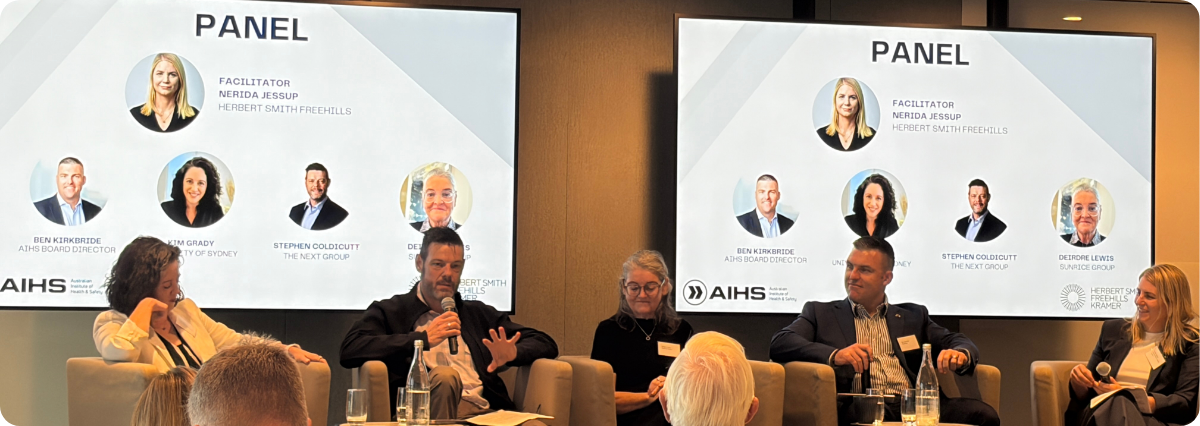
I had the privilege of joining Kim Grady (Chief Health, Safety and Wellbeing Officer, University of Sydney) and Deidre Lewis (Group Director, SunRice Group and Ben Kirkbride (Board Director, AIHS) on the panel facilitated by Nerida Jessup at the NSW AIHS OHS Breakfast in May, hosted by Herbert Smith Freehills Kramer. Ben opened proceedings with a sharp summary of where the profession sits right now - psychosocial risk, AI, enforcement, and leadership accountability - and the panel picked it up from there.
A few things from the conversation have resonated with me. Here's what I think HSE professionals should be taking seriously heading into the second half of 2026.
1. Stop Confusing Effort with Strategy
The opening question to each panellist was: what has genuinely moved the dial in your organisation over the past 12 months? What came back - across three very different organisations - was a consistent theme: the practitioners doing the best work have stopped adding programs and started asking what their programs actually do.
Kim pushed back on the 12-month frame entirely, debating that meaningful safety change does not show up in annual cycles - and that chasing short-term wins often undermines the longer work. Deidre described shifting SunRice Group's KPIs away from frequency rates toward critical risk controls in just three months and is already seeing the cultural impact on site.
"Don't confuse effort with strategy. We've seen a real shift away from the traditional compliance model toward business partnering and capability. Safety is being seen as part of the leadership team now in most organisations -
and the ones that aren't there yet are probably the ones that are lagging behind."
- Stephen Coldicutt, Associate Director, The Safe Step
Ben put it in broader context in his opening remarks, noting that the questions SafeWork NSW were grappling with in recent consultations are the same ones being debated in rooms like these: how to manage psychosocial risk at scale, how to respond to AI changing the nature of work, and how to make leadership accountability real rather than just a legal concept.
2. The Role Is Expanding - The Skills Need to Match
Across the whole conversation, one thing kept surfacing: what HSE professionals are being asked to do has expanded dramatically, and the technical knowledge that got most of us into this field is now closer to the minimum standard than the differentiator.
Kim described her role shifting from leading a health and safety team to helping colleagues manage whatever they're responsible for in a safe and healthy way - showing up in every boardroom conversation, not just the safety ones. Deidre spoke about getting the safety strategy connected to the capital planning process and saying no to initiatives that don't serve it.
"Business partnering skills and influencing others is actually becoming just as important as the technical stuff.
The technical is almost a given. The dial has shifted towards having a seat at the table and being seen as a senior leader."
- Stephen Coldicutt, Associate Director, The Safe Step
I do hear from some practitioners: 'But I'm not a psychologist.' And that's understandable. But the answer isn't to resist the expansion of the role, it's to invest in the skills that go with it.
3. The Generosity of This Profession Is One of Its Greatest Assets
This was the moment in the morning that I found most energising - and something we don't say enough publicly.
Kim was talking about the challenge of navigating psychosocial risk when she made a pivot that deserves its own spotlight:
"Safety people are pretty good at lifting those barriers of 'This is commercial confidence' - we don't generally believe in any of that. Actually, regularly talk to your peers working in similar industries that you can share practical documents with."
- Kim Grady, Chief Health, Safety & Wellbeing Officer, University of Sydney
Deidre's response was immediate:
"The generosity out there is immense. People are having a crack at all sorts of different ways of doing things. I've never had anybody come back and say they wouldn't share. You're on a hamster wheel; you've got to get it done - but somebody else has done the thinking and the grunt work. And if you can share it, it just makes it so much easier."
- Deidre Lewis, Group Director, SunRice Group
I can only echo this from what I see across the market. If you're not actively building peer coalitions and sharing what you know, you're making your job harder than it needs to be.
4. AI: Real Opportunity, Real Governance Risk
The AI conversation was more grounded than the hype you see elsewhere. The panel broadly agreed the opportunity is significant - predictive analytics, risk assessment, drone-enabled inspections, job redesign.
But the pattern I keep seeing across organisations is enthusiasm running well ahead of strategy:
"Predictive analytics is huge, and we're certainly exploring that. It doesn't replace safety — it enables safety to be more effective.
But speed in itself is inherently a risk. Which is where that human element still has to reside — to make sense of what the data is telling you."
- Ben Kirkbride, Board Director, AIHS
Final Thoughts
Walking out of the breakfast, what struck me most wasn't any single insight - it was the quality of the people in the room. Practitioners genuinely wrestling with hard problems, sharing what they know, and pushing each other forward.
The profession is in a unique position right now. Psychosocial regulation, digital transformation, economic pressure and constant organisational change have placed health, safety and wellbeing at the centre of some of the most important conversations happening in Australian businesses. The HSE professionals who will thrive are the ones who recognise that - and evolve their skills accordingly.