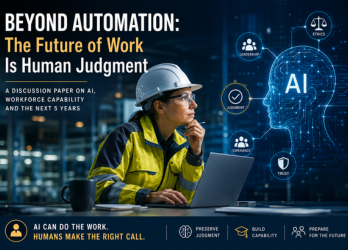
The Judgment Deficit
For centuries, professionals have developed expertise through apprenticeship. Junior employees performed routine work. They made mistakes. They received feedback. Over time, they developed judgment, the ability to interpret context, recognise weak signals, and make sound decisions under uncertainty.
AI is now absorbing much of that routine work. Reports that once took days are generated in minutes. Analyses that required years of pattern recognition are produced instantly. Compliance monitoring that demanded constant vigilance runs autonomously.
This creates a paradox. The more capable AI becomes, the fewer opportunities humans have to develop the expertise needed to supervise it. I call this the Judgment Deficit, not a shortage of intelligence, but a shortage of the lived experience that produces wisdom.
Think of it like GPS navigation. It gets you there efficiently.
But use it exclusively for long enough, and your independent navigation ability atrophies.
Now apply that dynamic to professional judgment across an entire workforce.
It's Not AI Use That's the Problem, It's How You Use It
Recent research draws a critical distinction that most organisations are missing.
Unstructured AI use, simply asking AI to produce outputs, damages learning. Students who use AI this way perform worse, not better. But structured AI use, where AI acts as a challenger, asking questions and providing feedback rather than answers, can significantly accelerate capability development.
Consider two scenarios. In the first, a junior professional asks AI to write an incident investigation report. The AI produces something polished and plausible. The professional submits it. They learned nothing. In the second, an AI system asks: "What evidence have you collected? What assumptions are you making? Have you considered who owns the control that failed?" It refuses to generate conclusions until the professional has worked through the analysis themselves.
Same technology. Opposite outcomes. The difference is design intent.
Most organisations will deploy AI the first way, because it's faster and cheaper. The organisations that thrive long-term will deploy it the second way, because it builds the capability that governs everything else.
What AI Cannot Replicate
There's a category of professional work that resists automation regardless of how capable AI becomes. It's not about technical limitation. It's about legitimacy.
In safety-critical environments, trust is not rational, it's relational. A respected leader who has demonstrated commitment to their team's safety and wellbeing, who was present during the last crisis, who shares the same vulnerabilities, that leader has earned the right to ask people to change behaviour. AI hasn't earned anything.
Three things AI cannot replicate:
moral authority (earned through demonstrated care),
shared vulnerability (being subject to the same risks you ask others to manage), and
accountability (being the person who answers when things go wrong). These aren't technical gaps that future AI versions will close. They're structural features of how humans build trust.
This creates what I call a legitimacy ceiling, a point beyond which technical capability is irrelevant because people will not accept machine authority on matters of personal safety. Every profession that involves trust, accountability, and human relationships will hit this ceiling. Safety professionals are hitting it first.
The Role Blurring Problem
There's a related challenge that's less discussed. When AI enables non-specialists to produce specialist-quality outputs such as EHS, professional boundaries blur.
Research from
Wharton showed that when employees used AI, the distinction between technical and business roles collapsed. Everyone produced ideas in each other's domains. Applied to safety: when any operational manager can prompt AI to generate a risk assessment, a compliance analysis, or an investigation report, what is the safety professional actually for?
The answer isn't "nothing." It's "something different." The value shifts from producing outputs to governing the quality of AI-generated outputs, designing the systems within which AI and non-specialists operate, and intervening when situations exceed what AI-assisted generalists can handle. Fewer people, doing harder work, with higher stakes.
What This Means for EHS?
We write this as an EHS professional managing safety across multiple jurisdictions. This is not abstract for us, it is our profession’s immediate future.
EHS work sits at a unique intersection. It combines knowledge work that AI can automate, compliance monitoring, incident data analysis, regulatory tracking, training content development, risk assessment documentation, with physical-world work that AI cannot touch. Site walkthroughs where you smell an overheating electrical panel. Emergency evacuations where a human voice and physical presence are non-negotiable. The quiet conversation with a worker who has been taking shortcuts. The challenge to a senior leader who is normalising risk under delivery pressure.
AI will write better incident reports than most junior professionals. It will track regulatory changes across jurisdictions faster than any team. It will identify patterns in injury data that humans miss. None of that replaces the professional who walks a floor and feels that something is wrong before they can articulate what, or who stands in front of a regulator and defends a decision under scrutiny.
The EHS profession is an early indicator for every profession that combines technical knowledge with human trust, physical presence with analytical capability, and regulatory accountability with cultural influence. What happens to us in the next five years will happen to legal, medical, engineering, and financial professionals in the decade that follows.
That is why getting this right matters beyond our profession.
The Equity Question
The benefits of AI will not distribute equally. Senior professionals with resources, access, and organisational support will be augmented, they'll become more productive and more valuable. Junior professionals whose routine work gets automated may simply be displaced, without the developmental experiences that would have made them tomorrow's senior professionals.
Across diverse economies, this creates a widening gap. Well-resourced organisations invest in deliberate capability development. Under-resourced ones use AI to eliminate positions. The result: a two-tier profession, a small elite of AI-augmented governance professionals, and a large displaced workforce of former practitioners.
This isn't inevitable. But preventing it requires deliberate intervention, not market forces.
Conditional Optimism
I'm neither a pessimist nor an optimist about AI. I'm a conditional optimist.
The optimistic future, where AI amplifies human capability rather than replacing it, requires specific conditions to be met. Organisations must value judgment over pure productivity. AI must be deployed as augmentation, not replacement. Apprenticeship models must be redesigned, not abandoned. Professional identity must shift before displacement makes the old identity worthless.
Several of these conditions are already at risk. The economic incentive favours replacement over augmentation. Most organisations optimise for quarterly metrics, not decade-long capability building. And professional identity shifts are slow, they typically happen only after crisis.
The window for action remains open. It will not remain open indefinitely.
Perhaps the real shift here is less about technology and more about how the profession evolves. Many of us came into EHS through doing, walking sites, writing reports, learning through mistakes, and gradually building the confidence to speak up when it mattered. As AI takes on more of that visible work, it creates space for something more meaningful to emerge.
Our value becomes less about producing outputs and more about shaping outcomes. It is the ability to sense when something is not quite right, to ask better questions, to guide decisions in moments that are not clear cut. In that sense, AI is not taking something away, it is giving the profession permission to elevate itself. It allows us to focus more deeply on what always mattered most, protecting people, influencing culture, and showing up where human judgment makes the difference.
What To Do
For individuals: become AI-literate, but protect your independent reasoning. Seek complex experiences that AI cannot replicate. Build the human capabilities, communication, leadership, ethical reasoning, that constitute the legitimacy ceiling.
For organisations: before deploying any AI tool, ask whether it replaces developmental work or augments expert work. If it replaces developmental work, design an alternative pathway for building the capability that work previously developed. Measure capability growth alongside productivity.
And govern what your AI systems optimise for — because whoever sets the goal shapes the outcome.
The organisations that thrive will not be those that automate the most. They will be those that develop the most wisdom.
The future belongs to organisations that combine artificial intelligence with human judgment. Getting that combination right is the leadership challenge of the next decade.
Authors: